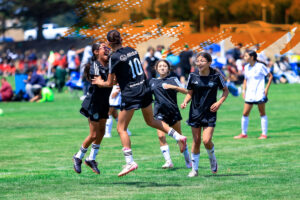
Salinas has long been widely known for its bountiful agricultural fields. But according to lifelong Salinas resident Jonathan De Anda, the city will soon be known for a different kind of field – soccer fields.
The Salinas Regional Sports Complex, a 68-acre development across the street from Natividad Medical Center, is quickly becoming a landmark in the soccer world, said De Anda, general manager of the facility. The aim, however, is much bigger than soccer.
While much of it is still in progress, when completed, the Complex is slated to be the largest facility of its kind between San Francisco and Los Angeles, said De Anda.
Currently, the Complex consists of 15 soccer fields – two synthe5c turf, 13 natural grass – which already attract an estimated 11,500 guests per week.
After years of planning and development and around $18 million invested to date, the founders hope to bring health and economic opportunity, not just to Salinas, but all of Monterey County.
Catherine Kobrinsky Evans, a commercial real-estate developer and Kurt Gollnick, a longtime Monterey County agriculturalist, founded the nonprofit organization, Salinas Regional Sports Authority in 2008. The two parents, who met through their children’s soccer teams, were dissatisfied with the state of the soccer fields in Salinas. “We wanted to change the narrative about the soccer quality around here,” Gollnick said.
The fields were in “terrible shape,” recalled De Anda, who grew up playing soccer in the area.
But beyond simply improving the quality of Salinas’s soccer fields, Evans and Gollnick saw the Complex as a broader part of changing old narratives about Salinas, from a city troubled by crime to a city of healthy lifestyles and economic opportunity.
Through the Salinas Valley Sports Authority, Evans and Gollnick have aligned with major sponsors such as Taylor Farms, The Harden Foundation and the David and Lucille Packard Foundation, among a constellation of other federal, state, local and philanthropic donors.
Already, the complex has proven to be an economic boon for the city.
From contractors, security, food service workers, janitors, trainers and referees, the Sports Authority es5mates that, when completed, the Complex will have generated somewhere between 99 and 181 full-time jobs.
According to Gollnick, the $18 million that’s been invested in the project “has been a local spend. We’re not spending money on people outside of our own community.”
In addition, the Complex’s original dream of attracting soccer lovers from out of county – even out of state and country now – has become a reality, bringing outside money with it to Salinas.
Just last month, the Complex hosted the Alianza Cup which drew over 27,000 attendees over the three days that it ran, said De Anda.
Thanks to tournaments like the Alianza, it’s estimated that the Complex will generate between $12.55 million to $25.25 million in economic impact annually.
And it’s not just Salinas that’s benefiting from the Complex. The Complex has registered leagues all over the county, from Castroville all the way south to King City.
This regional impact is an important part of the Sports Authority’s mission to fill the existing lack of access to fitness facilities in Monterey County. The most recent Monterey County Community Health Needs Assessment, released in 2022, found that access to recreation and fitness facilities is lower in Monterey County than both the state and nationwide averages.
In the coming years, the complex has big plans: more fields, sand courts, a skate park, a BMX track – even a 60,000-square-foot wellness center.
According to Evans, the next phase of construction, which will include seven new grass fields and a sand court for beach soccer and volleyball will be underway as soon as the requisite $3 million is secured.
“We’re totally ready…it’s just a question of money,” said Evans. “So we’re working really hard to raise that money through every source.”
Gollnick envisions that when complete, the facility could have upward of 25,000 visitors per week, what he calls “a huge hub of positive activity.”